
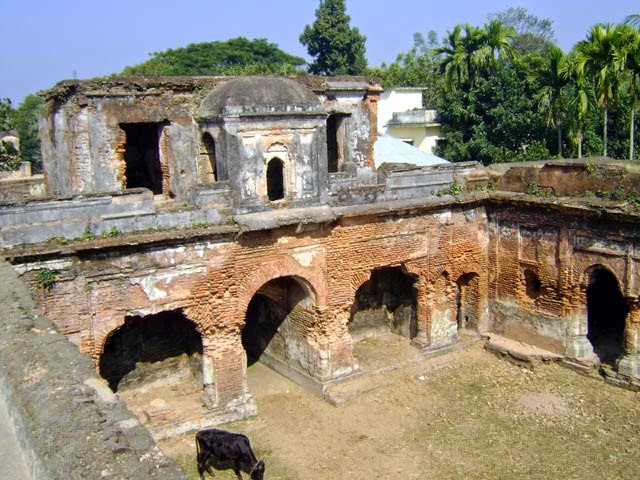
About Raja Sitaram Ray :
Raja Sitaram Ray : (1658–1714) was an autonomous king, a vassal to the Mughal Empire, who revolted against the empire and established a short-lived sovereign Hindu dominion in Bengal region of the Indian subcontinent.
Ancestry
Sitaram came from a family settled in the Fatehsingh region of Murshidabad. Ramdas Khan Gajdani, who became famous in the early 15th century by donating a golden elephant at his mother’s sraddha, belonged to this family. His son, Anantaram Das, was an official in Delhi. After him, the next few generations fell into penury.
The family rose again when Sriram Das gained the title of Khas Biswas from Man Singh, the then Mughal governor of Bengal. His son, Harish Chandra Das, rose to further prominence and obtained the title of Rai Raiyan from the Mughals. Harish Chandra’s son Uday Narayan, the father of Sitaram rose to the post of a tehsildar under the faujdar of Bhutan.
When Uday Narayan was posted at the Raajmahal, the capital of Bengal, he married Dayamayi, the daughter of a Kayas the Ghosh family of Mahipatipur in Katwa. Sitaram was born in Mahipatipur, the first child of Uday Narayan and Dayamayi in 1658, sometime before Aurangzeb ascended to the throne at Delhi. Sitaram’s mother was a brave woman. In her girlhood, she had fended off a band of dacoits with a khadga.
Childhood
When Mir Jumla transferred the capital back to Dhaka in 1660, Uday Narayan also moved to Dhaka. At that time, he did not bring his family with him. Shasta Khan became the governor of Bengal in 1664. At that time, Uday Narayan rose to the post of tehsildar and shifted to Bhutan. After a few years, he built a residence at Hariharan agar near the banks of Madhu Mati and brought his family there.
Sitaram spent his childhood at his maternal uncle’s home at Katwa. At school, he learned Sanskrit and, though Bengali was not taught at the chatuspathis, he studied it at home. He could recite Chandidas and Jaydev and had very good handwriting. As he began to grow up, he had to learn Persian, the official language of the Mughal Empire. Later, when he arrived at Bhusna, he picked up Urdu, during interactions with the Muslims. In his childhood, he also learned how to wield a lathi, and learned horse riding and fencing after arriving at Hariharan agar.
Early adulthood
While he was growing up, Sitaram used to frequent Dhaka, the provincial capital of Bengal. Shaista Khan was very impressed with his courage and work. At that time, a Pathan rebel named Karim Khan was wreaking havoc in the pargana of Satair. The Mughal faujdar had failed to suppress him and Shasta Khan wondered how to crush the rebellion. When Sitaram came forward to subdue the rebel, the governor sent him on the mission with a few thousand infantry and cavalry. Sitaram fought valiantly and Karim Khan was killed. Shasta Khan, very impressed with the success, rewarded Sitaram with the jagir of Naldi pargana.
Career
Reign as jaghirdar
After obtaining the jagir, Sitaram concentrated on building an army. At Dhaka, he became acquainted with a soldier of fortune named Rampur Ghosh, who accompanied him on the mission against Karim Khan. Rampur was not only a great soldier but also an accomplished strongman, well versed in wrestling. He was popularly known as Mena Hate, for he had killed a small elephant with his bare hands. Rampur became the chief of Sitaram’s army. Two other generals were Rupchand Dhali and Fakira Machhkata. Bakhtar Khan, a Pathan dacoit, and Amal Baig, a Mughal soldier, also joined his ranks.
After the death of Shah Jahan, the Mughal battle for succession left the province in turmoil. Lawlessness was rampant. Naldi was infested with dacoits and Sitaram had overcome them in order to restore order to the troubled pargana. Soon, the dacoity was suppressed and Sitaram became the savior of the masses, after which he began to be compared to the village deity Nishanath.
Sitaram built his residence in the village of Suryakunda, where the erstwhile revenue office was also located. Garrisons were set up both at Suryakunda and Hariharanagar. His father was still stationed at Bhusna and he visited him regularly. At this time, he added some talukas of Satair to his jagir.
Around 1684, Sitaram’s parents died in quick succession. After the sraddha, he went on a pilgrimage to Gaya. His secretary, Muniram Ray, and principal aide, Ramrup Ghosh, accompanied him. The affairs of the jagir were entrusted to his younger brother Lakshmi Narayan. After completing the ceremonial rites at Gaya, he traveled to the Mughal court at Delhi and made a plea for the vassal rule under the empire. In 1688, he was granted the title of Raja and additionally granted the right of Southern Bengal extending into the Sunderbans.
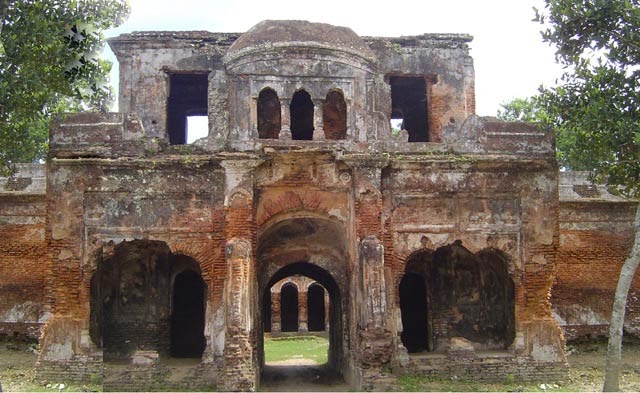
Reign as monarch
In the same year, Sitaram was ceremonially sworn in as the king of Naldi, Satair and the Bhati region of lower Bengal. Although he had become a king, he had no capital. Therefore, he constructed a fortified capital at Mohammadpur, near Suryakunda.
Mohammadpur was guarded on three sides by bills and on the east by Madhumati. The fort was square, with each side not less than 1,300 feet (400 m), built of earthen bricks and surrounded by a moat. Beyond the fort was a Subhadra. Therefore, he decided to act on his own.
Abu Trap was only a faujdar and, therefore, he had limited resources at his disposal. Whenever he sent his forces to subdue Sitaram, they were confronted with the archers and soldiers who manned the borders of Sitaram’s kingdom. In 1713, Murshid Quli Khan became the subedar of Bengal and Abu Trap approached him for help, which he ignored. Abu Trap sent his troops once again, but Sitaram opted for guerrilla tactics and frustrated the Mughal army in the unfriendly terrain. Unwilling to give up, Abu Trap deputed his commander-in-chief Per Khan, a Pathan to subdue Sitaram. The latter had set up his artillery along the banks of Madhumati and garrisoned his troops in the jungles in the track between Madhumati and Braais.
Sitaram’s troops met the Mughal army in the banks of Braais. During the battle, the Mughal army was defeated, and Mir Abu Trap was killed by Mena Hate. Sitaram’s army marched forward and captured the fort of Bhusna. Sitaram stationed a section of his army at Bhusna and put himself at the command of the fort. The Mohammadpur fort was put under the command of Mena Hate. The rest of the army was garrisoned along the Madhumati. Sitaram knew that the clash with the Mughals was inevitable. Sitaram, therefore, began to strengthen his army and reinforce his artillery.
As the news of Abu Trap’s death reached Murshidabad, Murshid Quli Khan immediately appointed his own brother-in-law Box Ali Khan as the new faujdar of Bhusna. He notified all the zamindars to assist the faujdar in subduing Sitaram. Box Ali Khan was accompanied to Bhusna by Sangram Singh the commander-in-chief of the provincial army of Bengal. Dayaram Ray, the principal aide of Raghuvamsa, the founder of the Nature estate, followed them with the zamindar’s army under his command. Box Ali Khan and Sangram Singh went along the Padma and embarked near Faridpur and then marched to Bhusna. Sitaram too marched forward with his troops and in the ensuing battle, the Mughals were defeated. The Mughal army surrounded the fort of Bhusna and Sitaram sensed that it would be difficult to hold on to both the forts at Bhusna and Mohammadpur.
In the meantime, Dayaram had marched to Mohammadpur with his forces. Knowing that it would not be easy for him to capture the fort in a direct battle, he conspired and had Mena Hate killed by sabotage, sending his severed head to Murshidabad. On receiving the news of Mena Hate’s death, Sitaram retreated to Mohammadpur with most of his troops. Box Ali Khan, too, followed him to Mohammadpur. Sitaram evacuated most of the civilian population from the fort and sent his family to Kolkata.
Dayaram and Box Ali Khan attacked the fort from the east and the south. After defending the fort for a long time, Sitaram was captured and Mohammadpur fell. Dayaram escorted him in chains to Murshidabad. At the trial, Sitaram was sentenced to death by Murshid Qulin Khan and his relatives were imprisoned for life. His final rites were performed at the banks of Ganges in Murshidabad.
Welfare
This section needs additional citations for verification. Please help improve this article by adding citations to reliable sources. Unsourced material may be challenged and removed.
Find sources: “Raja Sitaram Ray” – news · newspapers · books · scholar · JSTOR (February 2015) (Learn how and when to remove this template message)
Water reservoirs
Sitaram constructed a number of water reservoirs in the capital to meet the need of drinking water for the fort, city and the adjacent villages. The most famous of them was the Ram Sagar, a rectangular lake measuring 2,400 feet (730 m) by 900 feet (270 m). It had a depth of about 20 feet (6.1 m). Even in the summer, it sustained a water level of at least 12 feet (3.7 m). The reservoir was treated to prevent against any algal bloom. Towards the west of the fort, in the village of Harekrishnapur, Sitaram constructed another lake called Krishna Sagar, measuring 1000 ft by 350 ft. The excavated earth was used to raise earthen embankments at some clearance around the lake in order to prevent the flood water from contaminating the tank.
To the west of Ram Sagar, towards the beels, Sitaram constructed another tank named Such Sagar. It was squarish in shape, with each side about 375 feet (114 m). At the center, there was a three-story luxurious palace, which served as the summer retreat for the royal family. Mairangi boats ferried them to the palace in the middle of the lake.
Temples
Sitaram came from a Shakta family and was initiated into Shaktism in his early life. After setting up the capital at Mohammadpur, he erected an Ashtabula Temple there. When he visited his father in Bhusna, he used to frequent the Gopinath Jiu akhara. Gradually, he became attracted to Vaishnavism, becoming a disciple of Krishna Vallabh Goswami of Murshidabad, who initiated him to the faith. Sitaram erected a pancharatna temple dedicated to Hare Krishna in the village of Kananga to the west of the fort at Mohammadpur.
Marriages and children
Sitaram married the daughter of a Kaysha resident of Edilpore in Bhusna. She did not have any children, and very little is known about her. After obtaining the jagir of Naldi, Sitaram married Kamala, the daughter of a Kulim Kaysha, Sarala Khan Ghosh, a resident of Das Plash village in the district of Birbhum.[2] Kamala became his principal wife and, when Sitaram became king, she became the king’s consort. She bore him two sons, Shamsuddin and Surabaya. Sitaram’s third wife came from the village of Patulin, presently under Kata sub-division of Burdwan district. Though her name is not known, she bore him two sons, Ramdev and Jayde. Both sons died in childhood.

